
This is Feb 2026 the world, and there is a lot of doom and gloom about AI (and some of it rightly justified). Peter H. Diamandis is one of the more most optimistic people on the planet who thinks tech and AI will bring immense abudance. In one of his recent podcasts, the panel is claiming AGI is here !
Why does AI stir so much of our emotions? what is it about AI that threatens our identity as a species? Let's rewind a little bit and start by understanding the history.
The academic discipline of computer science emerged in the 1960s, with a focus on programming languages, compilers, operating systems, and the mathematical theories supporting these areas. The first coordinated AI research at MIT began in 1959 when John McCarthy and Marvin Minsky founded the Artificial Intelligence Project.
But even before that optimism around building intellignet machines was high. The Dartmouth Summer Research Project on Artificial Intelligence was a 1956 summer workshop widely considered to be the founding event of artificial intelligence as a field.
We propose that a 2-month, 10-man study of artificial intelligence be carried out during the summer of 1956 at Dartmouth College in Hanover, New Hampshire. The study is to proceed on the basis of the conjecture that every aspect of learning or any other feature of intelligence can in principle be so precisely described that a machine can be made to simulate it. An attempt will be made to find how to make machines use language, form abstractions and concepts, solve kinds of problems now reserved for humans, and improve themselves. We think that a significant advance can be made in one or more of these problems if a carefully selected group of scientists work on it together for a summer.
AI Winters:
NN:
The Perceptron: Frank Rosenblatt of the Cornell Aeronautical Laboratory (though not directly at MIT in 1957, his work profoundly influenced the field) introduced the Perceptron, an early artificial neural network for pattern recognition, which later became a major subject of study at MIT.
The interesting thing is we do have Existence Proof:
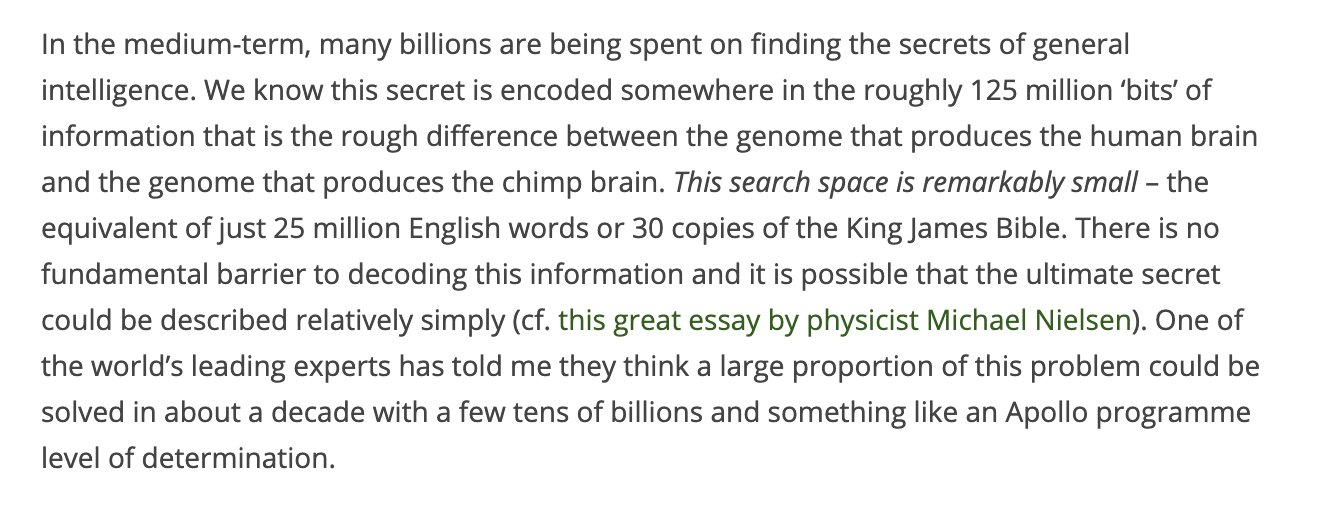
The marvel of the human brain is proof that general intelligence is possible; creating AI is as much a journey of discovery into the inner workings of our own minds as it is an invention. The evolution of a larger cortex equipped humans with greater intelligence, enabling us to build more complex and co-operative social structures, which eventually gave rise to all of modern civilisation. Similarly, AI can help us build radically new and improved ways of life. The very curiosity that led to the scientific method may well be the key—not only to solving society’s greatest challenges today, but to understanding ourselves and making sense of the universe around us.
How to define AGI:
After surveying some 70 informal definitions of intelligence proposed by various psychologists and artificial intelligence researchers, Legg and Hutter (2007) argue that the informal definition: “intelligence measures an agent’s ability to achieve goals in a wide range of environments”, broadly captures many important properties associated with intelligence. To formalise this intuition, they used reinforcement learning (Sutton and Barto, 1998), a general framework for goal achieving agents in unknown environments. In this setting, cycles of interaction occur between the agent and the environment. At each cycle, the agent sends an action to the environment, that then responds with an observation and (scalar) reward. The agent’s goal is to choose its actions, based on its previous observations and rewards, so as to maximise the rewards it receives over time. With a little imagination, it is not hard to see that practically any problem can be expressed in this framework, from playing a game of chess to writing an award-winning novel [10].
Building SIRI and ALEXA:
Understanding is a AI complete problem.
Car Wash and Reasoning with NNs:
In 2011 Demis Hassabis and others sold their company DeepMind to google for a cool half a billion dollars. At the time their only accomplishment was coming up with a single novel algorithm that could achieve super human performance in multiple Atari games. Since then DeepMind with a mission to solve intelligence and use that to solve everything else has come a long way. Challenging the traditional research model of academia they have been consistently coming up with results that can arguably be considered the biggest accomplishments in the field of AI while reviving interest in Artificial General Intelligence (which some argue was the original goal of the field).
There is no agreed definition of AGI. But typically we mean building a system capable of (solving) a wide range of tasks.
Before we dig deep into if and how that is possible. Lets start with a few observations on state of affairs:
Scaling up Deep Learning:
Engineering efforts are leading science in such areas — Most typical research is leaderboard driven where benchmark-centric evaluation methodology is followed (as opposed to Hypothesis-driven etc.) and most publications are focused on popular single paradigms(such as statistical pattern recognition) with tweaks to existing old math ideas and scaling them by throwing massive compute and datasets [2] [3].
When it comes to RL applications, most success so far in industry have been in offline settings. e.g google controlling their data centre cooling system by learning from past data. And given the fact that most of the community is not even focused on addressing these, its not clear how long it will take to for example solve fundamental problems(e.g reward design, generalization, sample efficiency, and exploration vs. exploitation dilemma. etc.) which the field of RL faces before it see mainstream adoption in building practical applications[4].
Good research takes a long time: ultimately coming with ideas that lead to general methods that can scale and leverage computation like those used in AlphaZero or Dota 2(but they still assume a model or simulator is available) are hard but worth pursuing[7]. Most serious ML/RL researchers seem to be sold on the following philosophy:
- Learning vs Handcrafted — Systems must learn from first principles
- General vs Specific (systems should operate across a wide range of tasks and environments out-of-the-box)
- Grounded vs Logic Based (ability to trace the origins knowledge system has created all the way back to the raw basic inputs)
- Active vs Passive Learning (classifier is passive vs agents based systems that are active participants in their own learning)
Towards AGI:
Most large scale AI systems deployed in industry (watson or Alexa etc) are not built on these principles rather they are multi-paradigm [6]. Most accomplishments in last 10 years have been in strong AI and AGI research is in very still primitive stages and has a still a long way to go e.g Here is a slightly old article [9] explaining the state of affairs in computer vision(poster child of ML success story) which are still mostly true today. But knowing all of this doesn’t stop all the enthusiasm in popular press or from famous researchers making all sorts of predictions. e.g some OpenAI researchers are confident that AGI is possible within 15years) [5].
Most academics would argue, that even though There is a lot of excitement in areas of AI research like Deep RL it seems like a lot of progress is empirical. Although there is no shortage of 'promising ideas' (proposed in top conferences). They argue, for the longest time, there hasn't been what we would call a ‘scientific breakthrough’ in past 10 years or so. e.g see talk by John Tsitsiklis [1].
what deep learning is appropriate for, and so far as I can tell, deep learning has little to offer such problems. In a recent review of commonsense reasoning, Ernie Davis and I (2015) began with a set of easily-drawn inferences that people can readily answer without anything like direct training, such as Who is taller, Prince William or his baby son Prince George? Can you make a salad out of a polyester shirt? If you stick a pin into a carrot, does it make a hole in the carrot or in the pin? As far as I know, nobody has even tried to tackle this sort of thing with deep learning. Such apparently simple problems require humans to integrate knowledge across vastly disparate sources, and as such are a long way from the sweet spot of deep learning-style perceptual classification. Instead, they are perhaps best thought of as a sign that entirely different sorts of tools are needed, along with deep learning, if we are to reach human-level cognitive flexibility. - Deep Learning - A Critical Appraisal
Here is what Sam Altman (founder of billion dollar startup openAI said a while ago):
To be clear, AI (under the common scientific definition) likely won’t work. You can say that about any new technology, and it’s a generally correct statement. But I think most people are far too pessimistic about its chances — AI has not worked for so long that it’s acquired a bad reputation. CS professors mention it with a smirk. Neural networks failed the first time around, the logic goes, and so they won’t work this time either.
But artificial general intelligence might work, and if it does, it will be the biggest development in technology ever.
Chat-GPT:
GPT-3 was a landmark moment in AI due to its unprecedented size, featuring 175 billion parameters, which enabled it to perform a wide range of natural language tasks without extensive fine-tuning. This model was trained using big data, allowing it to generate human-like text and engage in conversations. It also had the ability to perform few-shot learning, significantly improving its versatility and demonstrated usefulness in commercial AI applications such as chatbots and virtual assistants.
Going Forward:
There are certainly some reasons to be optimistic. Andrew Ng, who worked or works on Google’s AI, has said that he believes learning comes from a single algorithm — the part of your brain that processes input from your ears is also capable of learning to process input from your eyes. If we can just figure out this one general-purpose algorithm, programs may be able to learn general-purpose things.
and even with existing accomplishments, there is a lot that can be done in terms of producing value for business. Andrew Ng for example says he can’t imagine a domain where AI will have a huge role to play. But because we have seen two AI winters, every time the topic of AI comes up, everyone tends get a bit critical, which is not necessarily a bad thing(overhype is always bad).
What are the essential ingredients needed to build AGI systems? and what are the limitations of current methods?
One of the key challenges of building intelligent people facing systems is learning quickly from few examples, and giving the systems common sense and reasoning abilities.
These issues have been acknowledged by both RL and other AI communities. e.g by researchers like Emma Brunskills at stanford, Brenden M. Lake, Tomer D. Ullman, Joshua B. Tenenbaum at MIT and folks that work on topics like transfer learning and learning to learn.
In [10] authors review essential ingredients for building an AGI system that learns or thinks like a person and state that machines should:
“(a) build causal models of the world that support explanation and understanding, rather than merely solving pattern recognition problems; (b) ground learning in intuitive theories of physics and psychology, to support and enrich the knowledge that is learned; and harness compositionality and learning-to-learn to rapidly acquire and generalize knowledge to new tasks and situations.”
On the Engineering side its interesting to ask how will we build future generations of AI systems? it seems like apart from DL/RL, recent advances in “probabilistic machine learning (Ghahramani 2015), automated statistical reasoning techniques (Lloyd et al. 2014), automated techniques for model building and selection (Grosse et al. 2012), and probabilistic programming languages (e.g., Gelman et al. 2015; Goodman et al. 2008; Mansinghka et al. 2014) are promising technologies and will likely play a key role”.
These challenges and ingredients to consider have been discussed in detail in [10] [11] [12]. we will discuss specific instances of these in coming posts.
To realize the dreams and impact of AI, requires autonomous systems that learn to make good decisions. To get there we need to create AI systems that learn from few samples to robustly make good decisions, motivated by our applications to healthcare and education. This will have a tremendous impact on society. e.g Safe AI would enable:
- AI-enabled infrastructure: where need new approaches where AI can be embedded into objects and services to provide ambient intelligence and new kinds of experiences.
- AI-Enabled business processes: We need new tools and workflows for designing our processes where AI can provide automation and decision-support
- AI-as-collaborators: Intelligent machines could one day become capable partners in creative process
I recommend reading stanford's annual AI index report for an accurate picture of our progress.
AI and any advanced technology comes with its own sets of challenges, therefore its vitally important that we spend time thinking about how we as a society can create technologies that are safe, regulated and work towards creating a more egalitarian society where we welcome and create space for a diverse next generation leaders that will help shape the future.
Pursuit of the Dream Machine: All of this brings us to idea that computers have always been bicycles for mind and that Net positive impact that technology can have on society as well as create abundance.
Outcomes:
- Bubble Bust
- Low Probability Race for AGI is a matter of national security:
- Gartner hype Cycle
- Industrial revolution

— — — — — — — — — — — — — — — — — — — — — — — — — — — — — — -
[1]https://youtu.be/OmpzeWym7HQ?list=TLPQMTkwMjIwMjAU0BnvKyg1cQ
[3] http://www.deeplearningindaba.com/uploads/1/0/2/6/102657286/principles_of_deep_rl.pdf
[4] https://slideslive.com/38917654/a-real-world-reinforcement-learning-revolution
[6] https://plato.stanford.edu/entries/artificial-intelligence/index.html
[7] http://www.incompleteideas.net/IncIdeas/BitterLesson.html
[8] https://cs.stanford.edu/people/ebrun/NIPS_2017_tutorial_brunskill.pdf
[9] https://karpathy.github.io/2012/10/22/state-of-computer-vision/
[10] Lake, Brenden M., et al. “Building machines that learn and think like people.” Behavioral and brain sciences 40 (2017).
[11] https://youtu.be/RB78vRUO6X8 (see slides at )
[12] Mikolov, Tomas, Armand Joulin, and Marco Baroni. “A roadmap towards machine intelligence.” International Conference on Intelligent Text Processing and Computational Linguistics. Springer, Cham, 2016.
[13] https://arxiv.org/pdf/1109.5951v2
 Tim Mucci