
What are the structural problems that the Trump administration is focused on solving? What is this administration’s vision for America? What are the implications for entrepreneurs and investors?
The international geopolitical world order is breaking down. Up until now, monetary/economic order dictated that countries like China manufacture inexpensively, sell to Americans, and acquire American debt assets. But we are entering an new era of de-globalization, where rules of monetary, political, and geopolitical orders are being rewritten at an unprecedented rate.
This article attempts to understand the biggest disruptions that are likely still ahead. But first we awnser, What are the underlying circumstances that caused US citizens to first elect Donald Trump and then Trump to implement massive tariffs, introduce a DOGE program, adjust taxes and so on.,
The United States' national debt currently over $34 trillion is the result of a combination of historical, structural, and policy-driven factors that have accumulated over decades. US Public Debt Per Capita is at a current level of 106.11K, up from 104.06K last month and up from 100.41K one year ago. This level of current debt level and the rate at which the government debt is being added to is unsustainable.
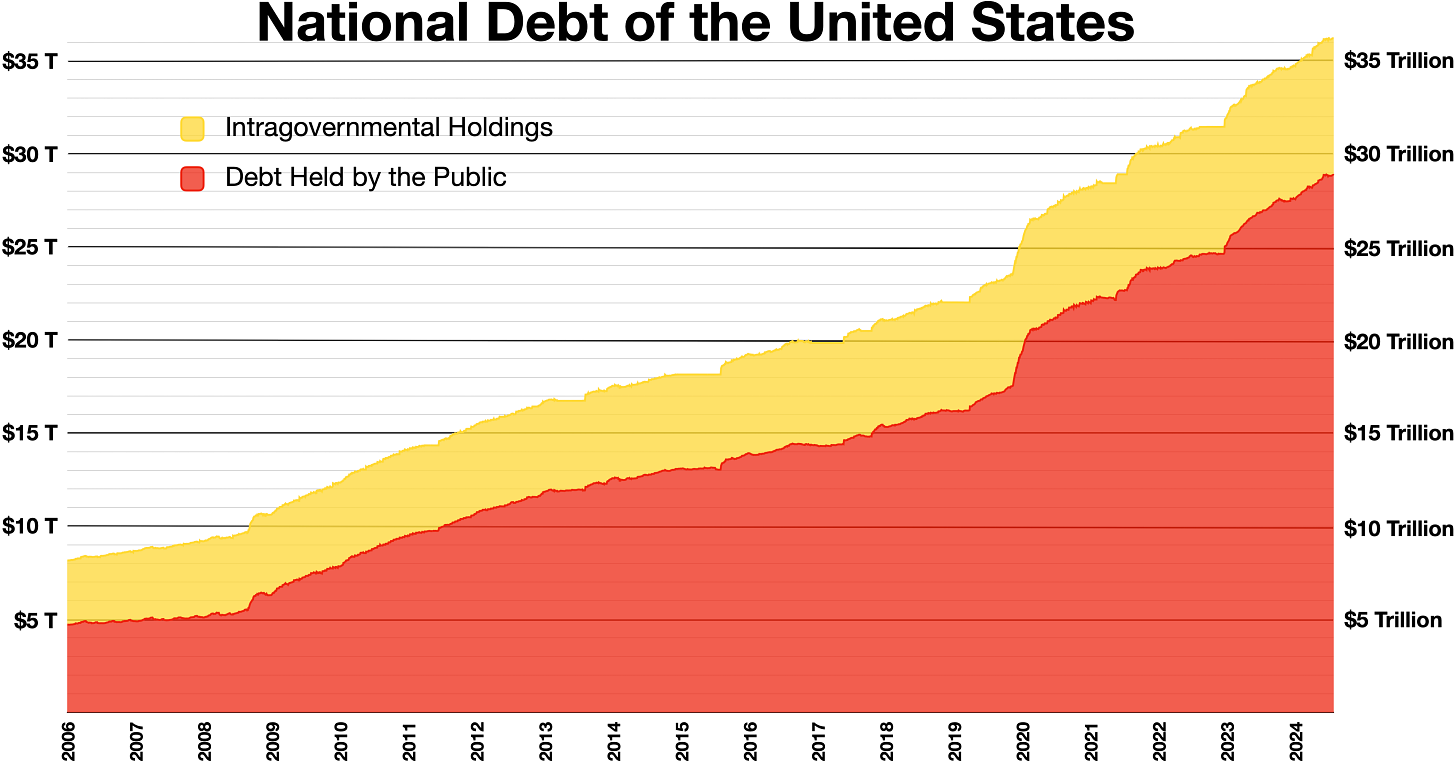
How Did the US Get here here?
Two third of American population is not college educated. Historically upward mobility was possible because there we lots of opportunities to find trade and blue colar jobs. But in recent decades, cheaper Chinese manufacturing - led to deteriorating of American manufacturing, which both hollows out middle class jobs in the U.S. and requires America to import needed items from a country that it is increasingly seeing as an enemy. It also leads to stagnation of wages for the white color jobs. All of this ultimately leads to breakdown of domestic political order due to huge gaps in people's education levels, opportunity levels, productivity levels, income and wealth levels, and values. History also shows that strong autocratic leaders emerge as classic democracy and classic rule of law are removed as barriers to autocratic leadership.
At the moment, the U.S. runs a budget deficit when its annual spending exceeds its revenue. These deficits are financed by borrowing (i.e., issuing Treasury securities). Over time, recurring deficits accumulate into large national debt. Even in good economic times, the U.S. often spends more than it collects due to entitlement programs and defense spending. Furthermore, Tax cuts, such as those in 2001 (Bush-era) and 2017 (Trump-era), reduced federal revenue without equivalent spending cuts.
In summary, Chronic budget deficits driven by entitlement spending, tax cuts, and military spending have been a driving force with interest rate projected to compound each year until the whole system is no longer sustainable and collapses (like the many empires of the past).
The biggest components of U.S. government spending are, Social Security, Medicare, Defense and Interest on debt !
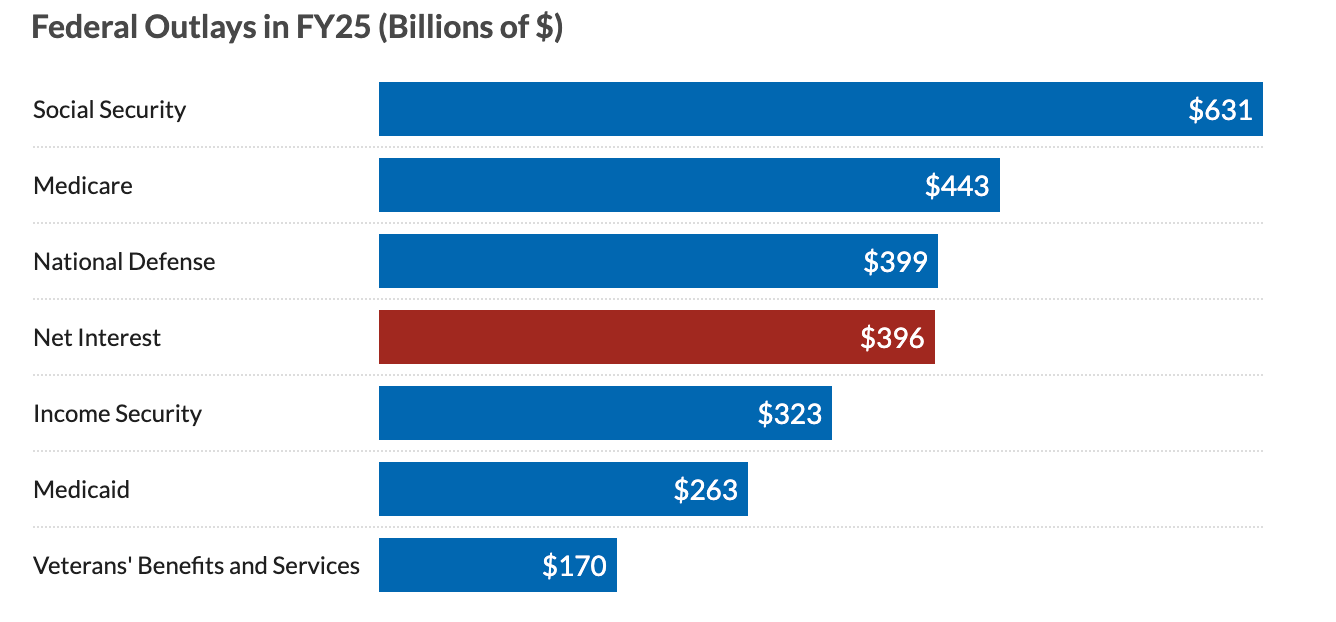
Many of these programs are politically difficult to cut and are growing due to demographic shifts, especially the aging Baby Boomer population (more retirees = more Medicare/Social Security spending).
The U.S. has borrowed heavily in response to major events:
- 2001–2020 wars (Afghanistan, Iraq): trillions spent, mostly borrowed.
- 2008 Global Financial Crisis: stimulus packages and bailouts.
- 2020 COVID-19 pandemic: unprecedented $5+ trillion in relief spending.
These crises were partly unavoidable, but they contributed massively to the debt.
Interest Rates and Politics:
For more than a decade, US has been in a unique global position that has allowed it to borrow more easily than other nations. Additionally, U.S. borrowed at historically low interest rates, which made debt accumulation seem sustainable. Policymakers became less cautious about adding to the debt, as the cost of servicing it was low.

There always has been a political reluctance to raise taxes or cut popular programs as the political operation system encourages short-term decision-making.
This has now changed: interest payments are the fastest-growing part of the federal budget due to rising rates.
The seasoned Politicians can’t seem to do much about it due to political Gridlock and Short-Term Incentives.
- No long-term fiscal plan: U.S. politicians often avoid unpopular decisions like raising taxes or cutting benefits.
- Debt ceiling fights don’t reduce debt—they only delay or complicate borrowing.
- Populist pressure: There’s little political reward for fiscal discipline, especially when voters demand both low taxes and generous public programs.
Balancing the Budget:
There are two forces to worry about growth and inflation. and therefore, balancing a budget without brining along the congress:
- Cut Government spending (DOGE)
- Earn more
Understanding the Tarrif Policy:
Here is one theory explaining trump Govt. behaviour:
During a recent MSNBC segment, Rachel Maddow unpacked the bizarre origin of Donald Trump’s trade policy during his first term. In 2016, seeking to bolster Trump’s economic team, Jared Kushner searched Amazon for books on China. He came across Death by China, co-authored by a little-known UC Irvine professor named Peter Navarro. Impressed by its aggressive tone, Kushner contacted Navarro, who was soon advising Trump directly on trade policy.
Navarro became the architect of Trump’s sweeping tariff agenda. But as Maddow revealed, the intellectual foundation for Navarro’s views was alarmingly hollow. In multiple books and memos, he quoted a supposed trade expert named “Ron Vara.” The truth? Ron Vara never existed. He was a fictional character Navarro invented—an anagram of his own last name—used to legitimize arguments that lacked peer-reviewed backing or institutional credibility.
So America’s trade war is, in part, shaped by a dishonest man discovered through an Amazon search, citing a fictional economist he created in his own image. These tariffs aren’t actual strategy. It’s economic theater passed off as “policy” as the world watches the sequel unfold in real time. It’s the most ridiculous thing I’ve ever seen—as China prepares for full-scale economic conflict with the United States, none of this needed to happen.
Long Term Consequences and US-China Relations
Next we try to understand the the trajectory of GDP, growth and second and third order effect of this policy (by definition are hard to predict). We also try to summarise the long-term implications for markets and businesses.
In a post-coivd world, self-sufficiency is of paramount importance. In recent US has become world’s consumer (woth $20T). The current Trump administration has the mindset that they have the leverage, if we don’t buy it, they can’t produce it ! and so we (U.S) are the world’s customer and that the customer is always right. Its not clear if china can turn all the consumption inward and sell the goods to its own 1 billion.
Meanwhile China’s has had its own set of problems. They are facing slowest growth in decades, zero covid policy and crackdown of tech founders etc. lead to a state where its economic growth was 5% in recent years and if trade-wars continue could drop to 2.5% (according to projections by WSJ). Their attractivness as a recepient of forign investment (totalitariism eventually is reconginized loud and clear by momest members of the free countries). They have an aging population and from that prespective it seems they do need exports and can’t absorb everything they create. To stimulate growth govt is investing in tech sector. Other less favorubale options include cocnede defeat to whatever terms trump deamnds. Devalue Yuan by 205 or unleash a fiscal stimular (in the trillions).
US is also behind in a number of sectors, like the energy sector while china and india have been building massive electrical generation capacity which will have negative consequeneces as the fight for AI race intensciises (where energy needs are immense).
But the debt is unsustainable because the of the large imbalance between a) debtor-borrowers who owe too much debt and are taking on too much debt because they are hooked on debt to finance their excesses (e.g., the United States) and b) lender-creditors (like China) who already hold too much of the debt and are hooked on selling their goods to the borrower-debtors (like the United States) to sustain their economies. There are big pressures for these imbalances to be corrected one way or another and doing so will change the monetary order in major ways. For example, it is obviously incongruous to have both large trade imbalances and large capital imbalances in a deglobalizing world in which the major players can't trust that the other major players won't cut them off from the items they need (which is an American worry) or pay them the money they are owed (which is a Chinese worry).
So, the old monetary/economic order in which countries like China manufacture inexpensively, sell to Americans, and acquire American debt assets, and Americans borrow money from countries like China to make those purchases and build up huge debt liabilities will have to change. Clearly, the monetary order will have to change in big disruptive ways to reduce all these imbalances and excesses, and we are in the early part of the process of it changing. There are huge capital market implications to this that have huge economic implications, which I will delve into at another time.
similar positions to help you build a list of things that they might do—things like suspending debt service payments to "enemy" countries, establishing capital controls to prevent the free flow of capital out of the country, and imposing special taxes. Many of these things would’ve been unimaginable not long ago, so we should also study how these policies work. The breakdowns in the monetary, political, and geopolitical orders that take the forms of depressions, civil wars, and world wars, that then lead to the new monetary, political orders that govern interactions within countries, and the geopolitical orders that govern interactions between countries until they break down, have all happened repeatedly and are the most important things to understand well.
Overall, The multilateral, cooperative world order the U.S. led is being replaced by a unilateral, power-rules approach In this new order, the U.S. is still largest power in the world and is shifting to a unilateral, "America first" approach.
References:
I am not an economist. I wrote/compiled the article mainly for myself (using notes from following source).
- Ray Dalio Article on Don't Make the Mistake of Thinking That What's Now Happening is Mostly About Tariffs:
- All-in Interview with Scott Bessent Tresurer
- All-in interview with Howard Lutnick
- Short Dive: The Trump Administration's Fiscal Strategy
- ChatGPT